How to Write Product Titles That Sell (SEO + Conversion Guide 2026)
A great product title gets you found on Google AND gets people to click. Here's the exact formula for writing titles that do both - with real examples.
How to Write Product Titles That Sell (The 2026 Formula)
Most product titles fail because they try to trick or please the algorithm while completely forgetting the human buyer who reads the title. They either skip keywords entirely or make them invisible to search engines, or they pack them with so much fluff that real shoppers just scroll past. Either way, you lose money.
This guide gives you a formula for product titles that work for both SEO and conversion, with before-and-after examples you can apply today.
Quick Navigation
Your Product Title Is Your Most Valuable Line of Text
On most e-commerce platforms, the product title is the single most important piece of text for search ranking on Google. Google, Etsy, and store-builder SEO all index the title first. It's the headline of your product's search result. This is what the shopper will see at first glance. And if this should make sense to them, there is every possibility that they click and land on your page.
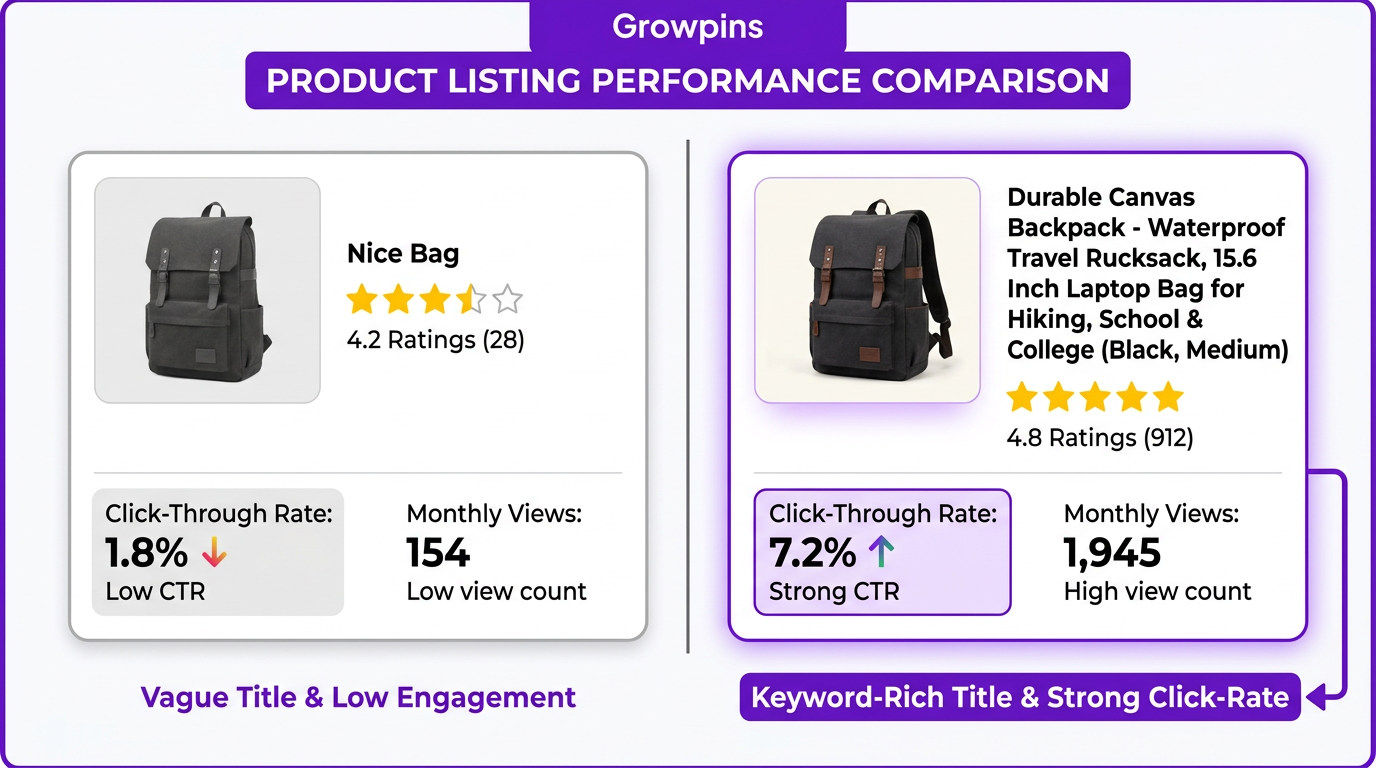
Product titles account for 40–60% of a product's organic click-through rate. A vague or generic title leaves that traffic on the table. A well-written title pre-qualifies the buyer before they even click. Meaning they're far more likely to convert when they land on your page.
A seller in Berlin rewrote 12 product titles using the formula below and saw organic traffic to her store climb 34% in six weeks. The seller did not change her photos, descriptions, or pricing. The title was the only variable thing she changed.
The Product Title Formula That Works
The most effective way to structure your product titles is this:
[Primary Keyword] + [Key Attribute] + [Secondary Benefit or Use Case] + [Optional: Size/Colour/Variant]
Each component earns its place.
Primary keyword - lead with what buyers search
Think like a buyer, not a seller. Use the words they type, not trade names or manufacturer codes. "Handmade silver earrings" not "925 sterling SS dangle pair #HE-447." The secret is to think like you are buying your own product. If you are to buy your product, how will you search for it
Key attribute - what makes yours specific
Material, size, finish, origin, style. "Handmade silver earrings - long drop" differs from "Handmade silver earrings - small stud." One attribute narrows the audience to the right buyer.
Secondary benefit or use case - who it's for
"For everyday wear," "Perfect gift for her," "Waterproof," "Office-ready." This is where secondary keywords live. It answers the buyer's unspoken question: is this for me?
Variant - only when it adds clarity
Colour, size, or quantity. Skip it if you only have one option. "Available in gold and silver" belongs in the description, not the title.
Before and After Examples
Before (weak) | After (strong) |
|---|---|
Nice bag | Handmade Tote Bag - Large, Waterproof Lining, Ideal for Work or Travel |
Candle | Lavender Soy Candle - Long Burn, Hand-Poured, Perfect Gift for Her |
Phone case | Shockproof iPhone 15 Case - Slim Matte Black, Drop-Tested Protection |
Baby dress | Handmade Cotton Baby Dress - 0–12 Months, Soft, Christening or Naming Ceremony |
Skincare product | Natural Turmeric Face Mask - Brightening, Reduces Dark Spots, All Skin Types |
Earrings | Beaded Statement Earrings - Handcrafted, Lightweight, Available in 12 Colours |
Every "after" title answers three questions in one line: what is it, what makes it special, and who is it for.
SEO Rules for Product Titles
Lead with your primary keyword
Search engines weight words earlier in the title more heavily. "Handmade leather wallet for men" will rank better for that search than "For men - handmade leather wallet." Put the most important keyword first. Full stop.
Use the exact terms buyers search.
Type your product into Google and read the autocomplete suggestions. "Handmade leather wallet for..." - if Google suggests "men," "husband," or "birthday gift for him," those are your phrases. Use them.
Keep titles under 70 characters for Google.
Google truncates titles in search results after approx. Ultimately 60–70 characters. Front-load the keywords. Save descriptive detail for the product description.
Include the location if your product is localised.
For products with local delivery or geographic identity, a location term captures local search intent: "Artisan Ceramic Bowl - [Your City]" or "Handcrafted Leather Bag - Made in [Your Region]."
Conversion Rules for Product Titles
Lead with the detail that earns the click.
The first words are what buyers see in search results and feeds. Lead with the most compelling detail - material ("Genuine Leather"), origin ("Handmade"), function ("Waterproof"), or audience ("For New Mums").
Specific numbers beat vague adjectives.
"60-Hour Burn Candle" beats "Long Burn Candle." "50 Botanical Ingredients" beats "Made with natural ingredients." Specificity signals quality. Vague adjectives signal nothing.
Include the use case or occasion.n
Buyers search by occasion: "birthday gift," "office bag," "wedding guest dress," "gym water bottle." Matching these signals in your title catches buyers at the exact moment of decision.
Cut sensationalism entirely
"Amazing," "best," "incredible" - these add no information and damage. Use adjectives that describe a real, verifiable attribute: "lightweight," "heat-resistant," "fast-drying."
What to Avoid
Keyword stuffing. "Bag leather women fashion tote work bag shopping bag" is a list, not a title. Google penalises it. Buyers will not connect with such a title.
All caps. ALL CAPS reads as shouting. It looks unprofessional, gets scrolled past, and is distracting.
Product codes in the title. Buyers don't search for "SKU-44229A-BLK." Save codes for internal reference fields.
Vague or generic titles. "Beautiful accessory" ranks for nothing and tells a buyer nothing.
Misleading titles. If the title says "gold earrings" and they're gold-plated brass, that's a trust violation that produces returns and bad reviews.
Frequently Asked Questions
How long should a product title be?
50–70 characters is the sweet spot for SEO. Your most important keywords must appear in the first 60 characters. On-platform searches may display longer titles, but every word should earn its place. Never pad titles for length.
Should I put my store name in the product title?
Generally no. Your store name appears elsewhere on the listing. The title is valuable real estate for product keywords and attributes. The one exception is: if your brand name is also the primary search keyword, which is rare for small sellers.
Can I use the same title formula for all my products?
Yes - the formula is consistent, but each title must be unique and accurate to that specific product. Never copy and paste titles with minor edits. Each product deserves a title based on its own keyword, attributes, and use case.
What if I have many product variants?
For the main product page title, use the primary keyword and the most featured variant. If each variant has its own listing, give each a unique title that includes the variant detail: "Handmade Tote Bag - Large Navy Blue" vs "Handmade Tote Bag - Small Rust Orange."
Can AI help write product titles?
Yes - Growpins' AI tools can generate keyword-rich product titles based on your product name, category, and key details. Use AI to generate a starting point, then review and refine with your knowledge of the product and your specific buyer.
Share this post
Have a question about this post? Contact the author