15 Best Shopify Alternatives for Small Business in 2026
Shopify costs adding up? Compare the 15 best Shopify alternatives for small businesses. Honest pricing, features, and which platform gives you the most for less
Published: May 21, 2026 · 11 min read
By Dokun Bamigboye · Founder, Growpins AI — based on platform cost analysis and seller migration audits across Nigerian, UK, and US e-commerce markets
Quick Navigation
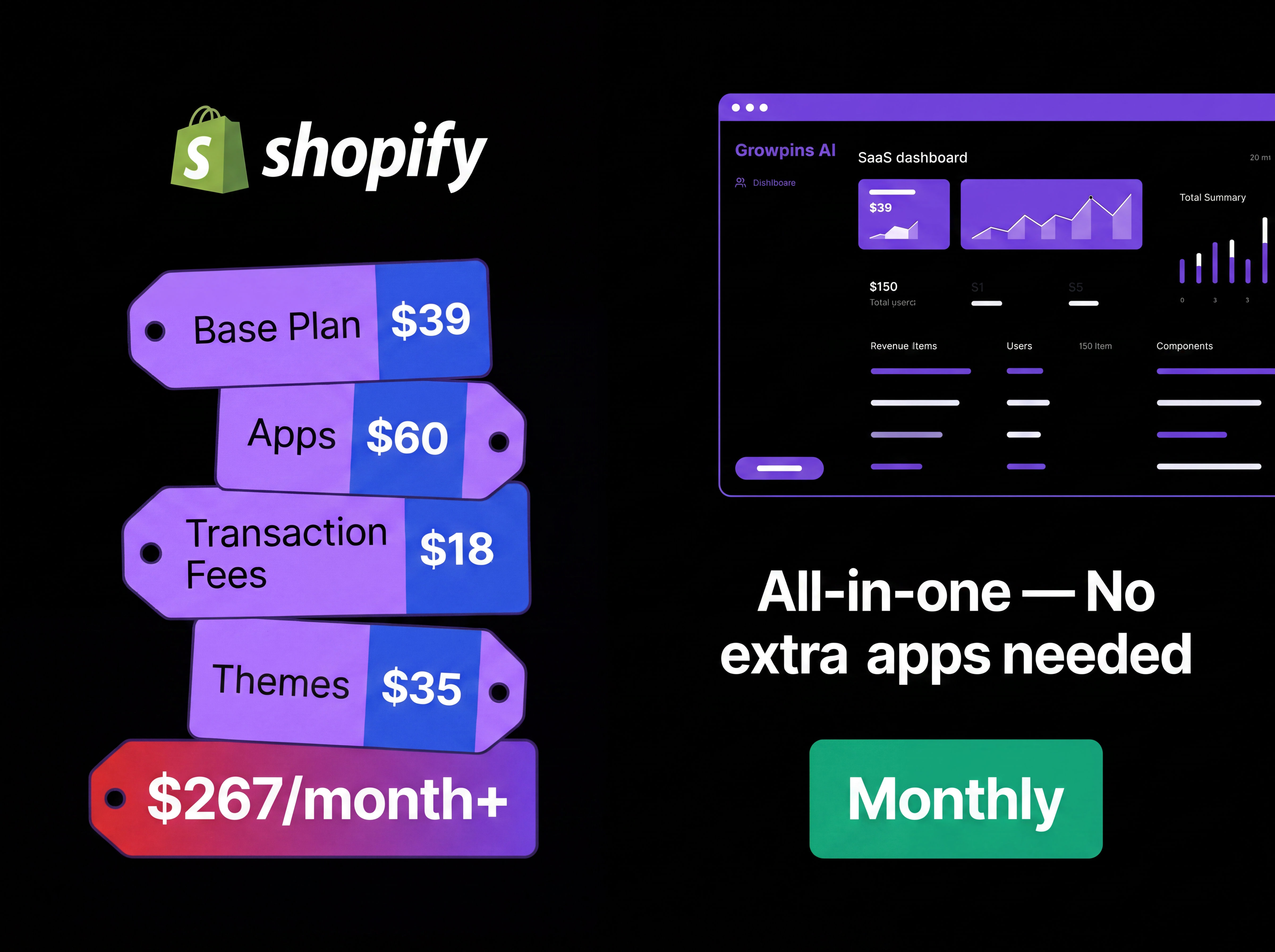
The Shopify Basic plan is $39/month. Add the apps a real store actually needs — an SEO tool, email marketing, product reviews, a currency converter — and you're at $150–$267/month before a single transaction fee. For a store doing under $3,000/month in revenue, that's a fixed cost that makes profitability harder every month.
The alternatives in this guide are genuinely different: some are cheaper, some include tools Shopify charges extra for, and some are purpose-built for specific seller types — digital products, service businesses, dropshipping, creators. Here's exactly what each platform costs, what it includes, and who it's best for.
Why Shopify Gets Expensive Faster Than You Think
Shopify's advertised Basic plan is $39/month — but that's not what most stores actually pay. Here's a realistic cost breakdown for a small Shopify store:
Cost Item | Monthly Cost |
|---|---|
Shopify Basic plan | $39 |
SEO app (e.g. Plug in SEO) | $29 |
Email marketing (Klaviyo starter) | $20 |
Product reviews app | $15 |
Currency converter | $10 |
Page builder (if needed) | $25 |
Transaction fees (2% on $3k revenue) | $60 |
Realistic total | $198–$267/month |
Transaction fees alone eat $60/month on a $3,000 revenue store. That's money that compounds against you every month — and it's avoidable. The platforms in this guide either eliminate transaction fees, include the apps you'd otherwise buy, or are simply priced for small business realities rather than enterprise accounts.
What to Look for in a Shopify Alternative
Before comparing platforms, know what actually matters for a small online store:
No transaction fees (or very low ones). Shopify charges 0.5–2% per sale unless you use Shopify Payments. On a $5,000 month, that's $100–$250 gone. Look for platforms with zero transaction fees.
Built-in SEO. Product pages need meta titles, meta descriptions, schema markup, and sitemaps. Some platforms include this. Others make you buy an app or hire an agency.
App independence. Every must-have app adds $10–$30/month and another login. Prefer platforms that include core functions — email, SEO, analytics — natively.
Ease of migration. If you're moving from Shopify, check whether the platform supports CSV import or has a dedicated migration tool.
Growth ceiling. If you grow to 1,000+ SKUs or $50k/month, will the platform handle it — or will you need to migrate again in 18 months?
The 15 Best Shopify Alternatives for Small Business
1. Growpins AI — Built-in SEO and AI Marketing Tools
Best for: Sellers who want Google rankings without a separate SEO tool bill
Price: Flat subscription, no transaction fees (see pricing)
Growpins is built differently from Shopify: it's an AI-native store platform where SEO isn't a paid add-on, it's the core product. Every product you list gets AI-generated meta titles, meta descriptions, and schema markup automatically. Your sitemap updates without any setup. Social content for each product is generated on upload.
What you replace when you switch from Shopify to Growpins:
Shopify SEO app (~$29/month) — included
Social scheduling tool (~$18/month) — included
AI copywriting tool (~$30/month) — included
Product description generator — included
The SEO difference is the one that matters most long-term. Shopify stores need a third-party app to apply product schema markup. Growpins applies Product JSON-LD schema automatically to every listing — which is what gets you star ratings and price shown directly in Google search results.
Not ideal for: Stores that need a fully custom storefront built on a design system they already own.
2. WooCommerce — Free (you pay for hosting)
Best for: WordPress users who want full control
Price: Free plugin + $5–$25/month hosting
WooCommerce runs on WordPress and is technically free — but you pay for hosting ($5–25/month), a theme ($0–$100 one-time), and potentially plugins. Total cost for a small store: $15–$60/month depending on what you need.
Advantages: Maximum flexibility. Thousands of plugins. You own the code.
Disadvantages: You manage security updates, hosting, backups, and performance. No built-in SEO — you need Rank Math or Yoast on top.
3. BigCommerce — $39/month (Standard)
Best for: Scaling stores that want Shopify-level features without transaction fees
Price: $39/month Standard — zero transaction fees on all plans
BigCommerce's biggest advantage over Shopify is zero transaction fees across every plan. For a store doing $5,000/month on Shopify Basic (2% fee), that's $100/month saved — which effectively pays for BigCommerce by itself.
BigCommerce also includes native SEO features that Shopify charges app fees for: full control over meta tags, canonical URLs, auto-generated sitemaps, and structured data support.
Disadvantage: Fewer theme options than Shopify. More complex to set up for complete beginners.
4. Wix eCommerce — $27/month (Core)
Best for: Very small stores that prioritise ease of use over scale
Price: $27/month Core eCommerce
Wix is the most beginner-friendly platform on this list. Drag-and-drop editor, no technical knowledge required. The eCommerce plans include unlimited products, a payment gateway, and basic inventory management.
What it lacks: Wix SEO has improved significantly but still lags behind purpose-built e-commerce platforms on product schema and structured data.
Best fit: A store with fewer than 50 products where ease of setup is the priority.
5. Squarespace Commerce — $28/month (Basic)
Best for: Visual brands — photographers, artists, makers
Price: $28/month Basic Commerce, no transaction fees
Squarespace's templates are the best-looking default designs of any platform on this list. If your brand relies on visual identity — fashion, art, design — Squarespace templates often require zero customisation to look professional.
The Basic Commerce plan has no transaction fees and includes basic SEO settings. You won't get automatic schema markup, but you can add it manually via code injection.
Disadvantage: Limited scalability for large catalogues. Not ideal for dropshipping stores.
6. Square Online — Free tier / $29/month Plus
Best for: In-person sellers who want to sell online too
Price: Free tier available (with 2.9% + 30¢ transaction fees on free plan)
Square Online is the right choice if you already use Square for in-person payments. Inventory, products, and payments sync automatically between in-person and online. The free plan is genuine — you pay transaction fees instead of a monthly fee.
Limitation: SEO capabilities are basic. Not ideal for stores that want to rank competitively on Google.
7. Ecwid by Lightspeed — Free tier / $25/month Venture
Best for: Adding a store to an existing website
Price: Free for up to 10 products; $25/month Venture
Ecwid's core use case is adding a product store to any existing website — WordPress, Wix, Squarespace, or even a basic HTML page. The free plan supports 10 products with no transaction fees, which is genuinely useful for service businesses adding a small product range. The Venture plan at $25/month adds unlimited products, discount codes, and abandoned cart emails.
8. Big Cartel — Free (up to 5 products) / $15/month
Best for: Artists, makers, and independent creators with small product catalogues
Price: Free (5 products) | $15/month Gold (50 products) | $30/month Platinum (500 products)
Big Cartel is built for independent artists and makers — simpler, cheaper, and more focused than Shopify. No transaction fees on any plan. The free plan is a legitimate business option for sellers with 5 or fewer products.
Disadvantage: Very limited built-in marketing and SEO tools. It's a catalogue and checkout, not a growth platform.
9. Sellfy — $29/month Starter
Best for: Creators selling digital products — ebooks, presets, templates, courses
Price: $29/month Starter, no transaction fees
Sellfy is purpose-built for digital product sales. It handles file delivery, VAT and tax compliance for digital goods, and a built-in print-on-demand option. If you're a creator who also wants to sell physical products, Sellfy handles both with the same checkout.
Not ideal for: Pure physical product stores with large inventory.
10. Gumroad — Free (10% transaction fee) / $10/month (3.5% fee)
Best for: Creators testing product ideas before investing in a full store
Price: Free with 10% fee per sale; or $10/month with 3.5% fee
Gumroad is the lowest-friction platform to start selling — you can be live in 10 minutes. But the 10% transaction fee on the free plan is expensive at scale. At $2,000/month revenue, you're paying $200/month in fees. Use Gumroad to test whether a product sells, then move to a dedicated platform once you're generating consistent revenue.
11. Shift4Shop (formerly 3dcart) — Free for US merchants
Best for: US-based stores that want a fully-featured free platform
Price: Free for US merchants using Shift4 Payments gateway
If you're US-based and use their built-in payment processor, Shift4Shop is genuinely free — unlimited products, no transaction fees, a full feature set including built-in SEO tools, email marketing, and abandoned cart recovery.
The catch: You must use Shift4 Payments. If you want Stripe or PayPal as your primary processor, the platform costs $29–$229/month.
12. PrestaShop — Free (self-hosted)
Best for: Technical sellers who want a fully customisable open-source platform
Price: Free software + hosting ($10–$30/month) + modules ($0–$500 one-time)
PrestaShop is an open-source e-commerce platform, free to download and self-host. Like WooCommerce, you manage hosting, security, and updates. The advantage: complete control, no monthly platform fee, and a large marketplace of free and paid modules.
Not ideal for: Non-technical users. The setup requires more work than any SaaS alternative on this list.
13. Webflow Commerce — $42/month (Basic)
Best for: Stores where design and custom interactions are essential
Price: $42/month Basic Commerce
Webflow gives designers complete visual control over every element of the store without writing code. If your brand requires a truly custom-designed storefront — not just a theme applied over a template — Webflow is the only platform that delivers it without a developer.
Disadvantage: Higher price point and a steeper learning curve than standard e-commerce builders. Transaction fees apply on lower plans.
14. Volusion — $35/month Personal
Best for: Traditional product stores that want an alternative to BigCommerce
Price: $35/month Personal, no transaction fees
Volusion has been around since 1999 and focuses on physical product stores. It includes built-in SEO tools, inventory management, CRM, and phone support — features Shopify charges extra for. No transaction fees.
Disadvantage: Dated UI compared to modern platforms. Fewer integrations than Shopify's app ecosystem.
15. OpenCart — Free (self-hosted)
Best for: Developers building multi-vendor or custom marketplace stores
Price: Free software + hosting costs
OpenCart is an open-source platform popular for multi-vendor marketplaces and stores requiring custom development. Like PrestaShop and WooCommerce, it's free to run if you manage your own hosting.
Not ideal for: Non-technical users or stores that need to go live quickly.
Shopify vs Alternatives: Feature Comparison Table
Platform | Monthly Cost | Transaction Fee | Built-in SEO | Built-in Email | Free Tier |
|---|---|---|---|---|---|
Shopify | $39–$399 | 0.5–2% (without Shopify Pay) | Basic (app needed) | No | No |
Growpins AI | Flat fee | None | Yes — automatic | Yes | Yes |
WooCommerce | $5–$25 (hosting) | None | Plugin needed | Plugin needed | No |
BigCommerce | $39–$399 | None | Good built-in | No | No |
Wix eCommerce | $27+ | None | Basic | No | No |
Squarespace | $28+ | None | Basic | Add-on | No |
Square Online | Free–$29 | 2.9%+30¢ (free plan) | Basic | No | Yes |
Big Cartel | Free–$30 | None | Minimal | No | Yes (5 products) |
Sellfy | $29+ | None | Basic | Yes | No |
Shift4Shop | Free (US) | None | Good built-in | Yes | Yes (US/Shift4) |
The Built-in SEO Gap: Why It Matters More Than Price
Most platform comparisons focus on monthly cost. The bigger long-term cost is the SEO gap.
Shopify's Basic plan gives you control over meta titles and descriptions, but product schema markup — which gets your price and star ratings showing in Google — and AI-generated descriptions all require paid apps. When you're comparing platforms, the most useful question to ask is this one: does this platform apply product schema markup automatically to every listing?
Schema markup is what tells Google "this page is a product, it costs $29, it's in stock, it has a 4.7 rating." Without it, your product pages look the same as regular web pages to Google — no rich results, no price shown in search, lower click-through rates.
Platforms that include product schema automatically: Growpins AI, BigCommerce (partial), Shift4Shop.
Platforms where you need an app or plugin: Shopify, WooCommerce, Wix, Squarespace.
Should You Migrate from Shopify?
Migration has a real cost in time and risk. Before moving:
Stay on Shopify if:
You have a custom theme you've invested heavily in
Your store runs on specific Shopify-only apps with no alternatives
You're generating $50k+/month and the platform cost is a small percentage of revenue
Consider switching if:
Your app stack costs more than $60/month on top of the platform fee
Transaction fees are eating into your margins every month
You're doing less than $3,000/month and want to reduce fixed costs
SEO is a growth priority and you're currently paying for a separate tool to handle it
For stores in the early growth phase — under two years old, under $5k/month — the math often favours a platform with built-in SEO and no transaction fees over Shopify plus a stack of apps. Growpins supports CSV product import and handles the SEO redirect setup for existing product URLs as part of the migration process.
Frequently Asked Questions
What is the cheapest Shopify alternative with no transaction fees?
Big Cartel is free for stores with up to 5 products and charges no transaction fees. For larger catalogues, Shift4Shop is completely free for US merchants using Shift4 Payments, with no transaction fees and a full feature set including SEO tools and email marketing. WooCommerce is also free — you pay only for hosting — with no transaction fees, though it requires more technical setup than a hosted platform.
Which Shopify alternative is best for SEO?
For automatic SEO without extra apps or setup, Growpins AI applies product schema markup, meta tags, and sitemaps to every listing automatically. BigCommerce and Shift4Shop also have strong built-in SEO capabilities. Shopify, Wix, and Squarespace all require third-party plugins or apps to reach the same level of structured data support at the product level.
Can I move my Shopify store to another platform without losing my Google rankings?
Yes, but it requires careful handling of URL redirects. When you migrate, your product URLs will likely change format — you need 301 redirects from old Shopify URLs to new ones so Google passes ranking credit to the new pages. Some platforms, including Growpins, handle migration redirects as part of the onboarding process. Always export your Shopify sitemap before migrating and verify redirects are in place before removing the old store.
Which Shopify alternative works best for sellers outside the US and UK?
Most platforms on this list are US and EU-centric — their payment integrations, supplier catalogues, and customer support are built around those markets. Growpins is the option most directly built for sellers in Nigeria, Ghana, Kenya, and other African markets, because it doesn't require a specific payment processor. You connect any payment link you already use — Paystack, Flutterwave, M-Pesa, or local bank transfer — and it works immediately without geographic restrictions.
Shopify is a capable platform — but for stores generating under $3,000/month, the real cost with apps, transaction fees, and SEO tools often runs past $150/month. The 15 alternatives above are cheaper, include more natively, or are better matched to specific seller types.
If SEO is a priority, a platform with built-in product schema and automatic meta generation is worth more than any tool you'd buy separately. If you're a creator, Sellfy or Big Cartel match your catalogue size better. If you want zero fees as a US merchant, Shift4Shop is genuinely free.
Start your Shopify migration to Growpins →
Related reading: How to migrate from Shopify to Growpins · Growpins vs Etsy: which is better for your store? · How to start an online store for free
Share this post
Have a question about this post? Contact the author